

Right to Play: How a Top VC Thinks About Backing Early Founders
Updated: Mar 24
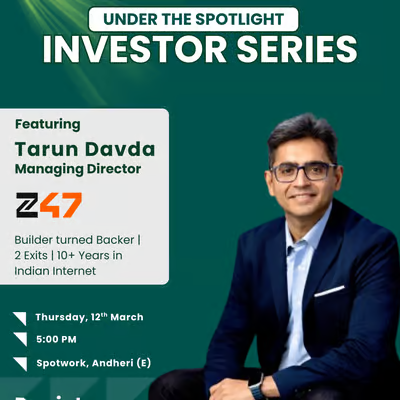
Notes from a talk by Tarun Davda, Managing Director at Z47, at a Spotlight Strategic Partners event in Andheri.
There's a particular kind of founder meeting that makes a VC lean forward. Most don't get there.
Last week, I was at an event hosted by Spotlight Strategic Partners, a firm founded in 2025 by Rajesh Mane and Ankit Jain that's building something interesting: early stage investing, an incubation cohort that takes ideas to MVPs, and a coworking space, all under one roof. The speaker was Tarun Davda, Managing Director at Z47 (formerly Matrix Partners India), who focuses on Seed to Series B consumer tech bets.
What followed was one of the more candid investor talks I've sat through. No platitudes about "backing exceptional founders." Just pattern recognition.
Where Tarun Started
Before the frameworks, there was a story.
Tarun grew up with a family business, a factory that manufactured chokes for tubelights in Mumbai. He graduated from VJTI in 2000. By the time he did, the factory had already shut down. He joined Infosys, which was young and moving fast, and spent 8 years there, 4 of them in the US.
That stint in the US was formative in a specific way. He was watching the internet being built around him. Consumer behavior shifting in real time. Companies going from zero to consequential in a few years. When he came back to India, he wasn't trying to copy Silicon Valley. He was trying to catch a wave he could see forming.
He co-founded BigRock (domain names) and Stepout (online dating), both early bets on India's internet story. He raised capital, met VCs, and eventually sold both companies. After his exits, Matrix Partners gave him an unusual choice: take a check for your next venture, or come sit on our side of the table. He chose the table. More than a decade later, he's still there.
The reason this backstory matters: Tarun isn't theorizing. He's been a founder raising money. He's been the one walking into those rooms. The advice he gives is structurally different because of that.
The Problem With How Most Founders Pick Ideas
Tarun's first question to any founder is deceptively simple: Do you truly feel this problem?
Not understand it. Feel it.
The distinction is sharper than it sounds. There's a class of founders who intellectually identify a large market, read reports, and construct a thesis. And then there's the founder who has lived inside the problem, worked in the industry, served the customer, run a business adjacent to it, or simply couldn't find a solution that existed.
The second type shows up differently in a conversation. They don't explain the market. They explain the frustration. The gap between what exists and what should.
But feeling the problem is only half the question. The other half is: what is your right to play?
This is underrated as a framing. Why are you the person solving this? Your right to play can come from a prior career in the domain, deep customer relationships, having lived the problem personally, a family history in the space. It doesn't have to be credentials. It has to be genuine. A founder who has worked in logistics for five years has a different right to play in a logistics startup than someone who read a McKinsey report and saw white space.
When both are present, real problem conviction and a legitimate right to play, something shifts in the room.
The Green Flags: What Winning Founders Actually Look Like
Tarun named names. Some of his early conversations with India's prominent founders.

In 2013, there were roughly 100 ride-hailing startups operating in India. Today, two remain. Ola's survival wasn't about the idea. It was about the speed and quality of execution. For example, when Ola decided to move from Mumbai to Bangalore, the shift happened at a pace most people still don't fully appreciate.
What Tarun highlighted wasn't that Bhavish had all the answers. It was that he was upfront about what he didn't know. Ask Bhavish a hard operational question in one meeting, and he'd come back to the next one with a detailed, researched plan. Not a deflection. A plan. That's a specific kind of intellectual honesty paired with execution speed that's very hard to fake.

He was being tracked by VCs before he quit Unilever. That's the detail worth sitting with. He wasn't on anyone's radar because he cold-emailed. He was on their radar because of his track record at a company they were already watching. When he left, the check came almost immediately. Since then, he's built a brand with what Tarun described as the lowest CAC in its category, great marketing, sharp storytelling, genuine product conviction.

This one is more instructive as a cautionary tale, even though it ended well. Utham was building in B2B seafood. Raised significant capital. Realized it wasn't working, too late, with most of the cash already burnt. What he did was remarkable: redeployed what was left to pivot into Captain Fresh, a company that has since scaled meaningfully.
The lesson Tarun drew from this isn't that pivots work. He was explicit: successful late pivots are rare. What makes Captain Fresh an exception is everything about Utham as a founder, his domain insight into the seafood supply chain, his ability to rebuild trust with investors mid-crisis, and frankly, some luck. Don't plan for the exception. It's a story of someone surviving a situation that kills most companies.
The Immediate Turn-Offs
Tarun was refreshingly blunt on what makes him disengage fast.
A banker in the process before Series B. It signals that the founder is optimizing for valuation extraction rather than finding the right partner. At early stages, the relationship matters more than the headline number. A banker in the room tells you the founder might not fully understand that.
A pitch anchored on TAM. The total addressable market slide is almost never the point. If your entire opening thesis is "this is a $50B market," you've already lost the thread. Sophisticated investors aren't asking whether the market is big. They're asking whether you understand it in ways others don't.
Incubators and mentors on your cap table or advisory board, prominently featured. Particularly before you've demonstrated anything. It can signal that the founder is substituting other people's credibility for their own earned insight.
Premature certainty. If a founder walks in knowing exactly what their revenue will be in Year 3, it reads as either dishonesty or inexperience. At early stage, the only honest answer to long-range projections is "I don't know, here's how I'll find out." Confidence in the problem is different from false precision about the future.
Rocket Internet-style cap tables. Where the founding team owns 10%, heavily diluted by corporate venture and incubators before they've even proven the model. The incentives are misaligned in ways that are almost impossible to fix downstream.
The Fundraising Mechanics That Founders Get Wrong
Two specific points on timing and sizing:
Most founders raise too late. They run the business down to a few months of runway, then start the fundraising process. The problem is that fundraising, even when it goes well, takes 6 to 9 months. Starting from a position of desperation compresses your options and your leverage.
The rule of thumb Tarun offered: start the process when you have 12 months of runway. Raise enough to last 24 months.
Raise enough to actually build. Not enough to "see what happens in 6 months." That's not a plan, it's a gamble with your team's time and your own credibility.
How to Get on a VC's Radar
Z47 meets roughly 2,500 startups annually. 15 get funded. That math is unforgiving.
Tarun outlined four channels, in descending order of effectiveness:
1. Being tracked at a company. VCs build watchlists of high-performers at companies in the verticals they care about. If you're doing exceptional work at a company in a space a fund covers, you may already be on someone's list without knowing it. When you leave to build, the call comes.
2. Intros from portfolio founders. The most credible signal a VC can receive is a founder they've already backed saying "you should meet this person." It's warm, it's vetted, and it carries real reputational weight.
3. Intros from preceding-stage investors. Angel investors, scouts, and seed funds who know a VC's thesis and pass along companies at the right moment. High-quality intros from the right angels carry weight.
4. Cold outreach. The least effective channel, but not zero. The ones that work are precise, short, and demonstrate that the founder has actually thought about why this fund and this partner, not a blast to a list.
The theme across all four: signal before you need capital. The best time to get on a VC's radar is when you don't have your hand out.
The Line That Stayed With Me
Tarun said something offhand that I keep coming back to:
The founders who win have blinding insight into their industry.
Not information advantage. Not a better deck. Blinding insight.
It's the kind of thing that sounds like a cliché until you hear the Bhavish story and the Shashank story back to back. In both cases, there was something about how they saw their space, the supply-side dynamics of ride-hailing, the dysfunction of health food marketing, that nobody else had articulated quite that way. And when they explained it, you couldn't un-see it.
That's what VCs are actually hunting for in 2,500 meetings. Not confidence. Not a large TAM. The thing where you explain your problem and the person across the table thinks: of course, why didn't anyone solve this before?
Spotlight Strategic Partners runs regular events like this one for early stage founders in Mumbai. Worth keeping an eye on their calendar if you're building.


Comments